Interval training for cyclists inspired by the Norwegian method
Interval training for amateur cyclists, shaped by the Norwegian method: submaximal threshold work, lactate control, and why hard sessions stay restrained.

Most amateurs do interval training the same way: 4×8 or 5×8 minutes as hard as possible. It is so common that nobody questions it. The Norwegian method, behind 20 years of elite Norwegian endurance training, does almost the opposite.
Intervals stay controlled. Each session is easier, but the weekly dose is higher. The fitness lasts through the season, not only for one peak.
Where this approach comes from
The framework comes from research by Stephen Seiler, Espen Tønnessen, Leif Inge Tjelta and Øyvind Sandbakk, mostly on Norwegian skiers and middle-distance runners. Main finding: elite endurance athletes train polarized. Roughly 80% of time below the first lactate threshold (LT1), 20% at or above the second (LT2), very little in between (Seiler, 2010, IJSPP).
The Norwegian part is how the 20% is done. Threshold intervals are capped at a target blood lactate, typically 2.5–3.5 mmol/L, instead of pushed to max. Athletes finish a session feeling they could do more, and this is by design.
The submaximal principle
Work just below maximal lactate steady state (MLSS) gives similar mitochondrial and capillary adaptations as classic threshold work. But fatigue per session is lower, so you can do more of it per week. Norwegian runners even do two threshold sessions in one day, the “double threshold” made famous by the Ingebrigtsen brothers (Casado et al., 2022, Sports Medicine).
So 5×8 minutes “as hard as you can hold” is not Norwegian-style interval training. It is a different stimulus. It has its place, but doing it every interval day gives you one heroic ride and four tired ones.
Interval training without a lactate meter
Most amateurs will never measure lactate at home. A power meter and some discipline are enough:
| Check | Target | Too hard if |
|---|---|---|
| Power | 88–95% of FTP, lower end early in a block | You regularly finish intervals at 100% of FTP |
| Heart rate | Around LT2, for most riders 88–92% of max HR | HR drifts well above that |
| RPE | About 7 out of 10 | The last interval is the hardest one of the season |
Simple check: at the end you should feel you could do one more rep at the same power. One, not three.
A practical interval training week
For a cyclist riding 7–10 hours a week:
- 3–4 easy rides below LT1. Conversational pace. This easy volume is the base of everything.
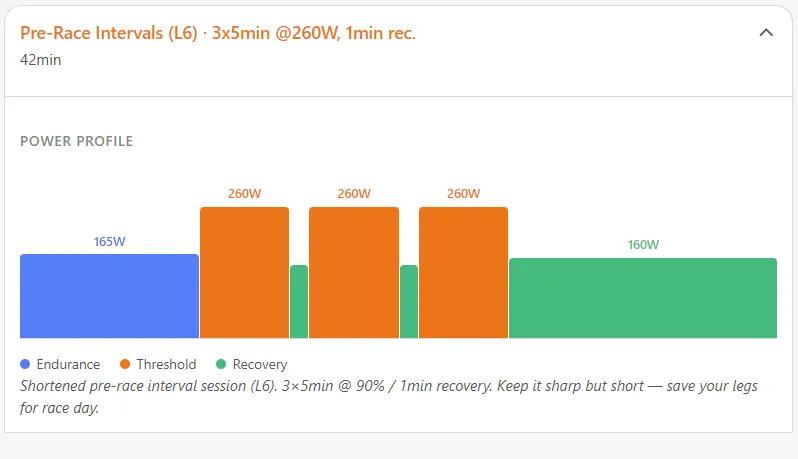
- 2 sub-threshold sessions, e.g. 4×5 minutes at 88–92% FTP with 2 minutes rest. Target lactate (if measured) 2.5–3 mmol/L. Superfly in this case will suggest repeating previous interval session and once two sessions are completed - raise your level. The higher the level, the more duration is spent at given intensity and less recovery time between intervals. A continuous progression.
- 1 full rest day.
The intervals have names, but the main work is the easy hours. Polarized training only works if easy rides stay really easy. This is the rule most self-coached riders break, and the core of the method.
Why amateurs should skip double-threshold days
Double threshold was built for athletes training 20–35 hours a week, with full-time recovery. Amateurs don’t have that base of easy volume. For an amateur the value of the method is not stacking sessions. It is making each interval session easier, so the weekly load is higher and repeatable.
Practical version for working cyclists: two sub-threshold sessions on different days, with at least 48 hours of easy riding between them. Threshold time per week goes up, fatigue stays under control, and the week stays polarized. Polarized training is what gave the best results in Stöggl & Sperlich, 2014, Frontiers in Physiology.
What this asks of you
The hard part is in the head. Sessions feel modest. No Strava PRs on these rides. Weekly TSS looks unremarkable. What you get is fitness that lasts through the season, without the boom-and-bust from training every interval day to failure.
FAQ
What is Norwegian-method interval training?
A polarized intensity split, around 80% easy and 20% hard, combined with submaximal threshold intervals. The hard work stays under lactate steady state instead of going to failure. So you can do more intervals per week.
How is the Norwegian method different from polarized training?
Polarized training describes the intensity split: a lot of easy, some hard, very little middle. The Norwegian method says how the hard part is done: controlled, under MLSS, often guided by lactate. All Norwegian-method training is polarized, but not all polarized training is Norwegian-method.
Do I need a lactate meter for this kind of interval training?
No. A power meter and honest RPE are enough. Ride 88–95% of FTP, keep heart rate around LT2 and finish feeling you had one more rep in you.
How many interval sessions per week is enough?
For 7–10 hours a week, one or two sub-threshold sessions. The rest stays below LT1. A third hard session usually makes the other two worse.
Should amateur cyclists try double-threshold interval days?
Almost never. Double threshold needs 20+ hours a week and full-time recovery. For amateurs, two sub-threshold sessions 48 hours apart give the same principle.
References
- Seiler, S. (2010). What is best practice for training intensity and duration distribution in endurance athletes? International Journal of Sports Physiology and Performance, 5(3), 276–291.
- Stöggl, T., & Sperlich, B. (2014). Polarized training has greater impact on key endurance variables than threshold, high intensity, or high volume training. Frontiers in Physiology, 5, 33.
- Casado, A., González-Mohíno, F., González-Ravé, J. M., & Foster, C. (2022). Training periodization, methods, intensity distribution, and volume in highly trained and elite distance runners: A systematic review. Sports Medicine, 52, 2007–2030.